
E-commerce SEO: How to Drive More Sales to Your Online Store
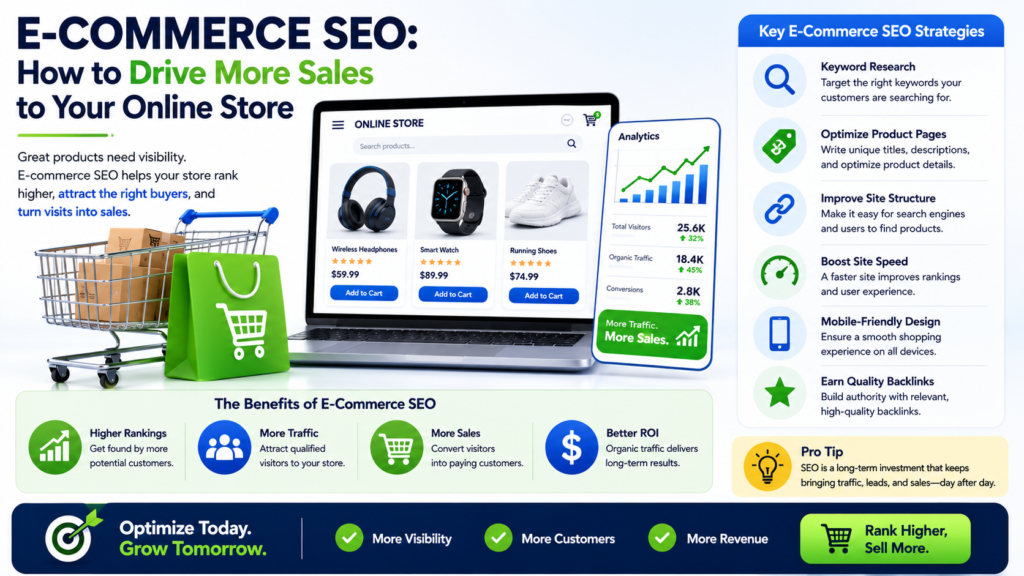
Running an online store is exciting, but with millions of e-commerce websites competing for attention, getting your products found on Google is one of the biggest challenges you will face. E-commerce SEO is the solution.
This guide walks you through the key e-commerce SEO strategies that help online stores attract more organic traffic, rank product pages higher, and ultimately drive more sales.
If you want expert support to improve your online store’s visibility, check out our Search Engine Optimization Services for proven growth strategies.
Why E-commerce SEO Is Different
E-commerce SEO has unique challenges that differ from a typical service business website. You might have hundreds or thousands of product pages, many with very similar content. You have category pages, filter pages, and sorting pages that can create duplicate content issues. You need to balance keyword optimization with persuasive selling copy.
Despite these challenges, e-commerce businesses that invest in SEO typically see their highest-ROI returns from organic search, because buyers who find your products through Google are actively intent on purchasing.
Keyword Research for E-commerce
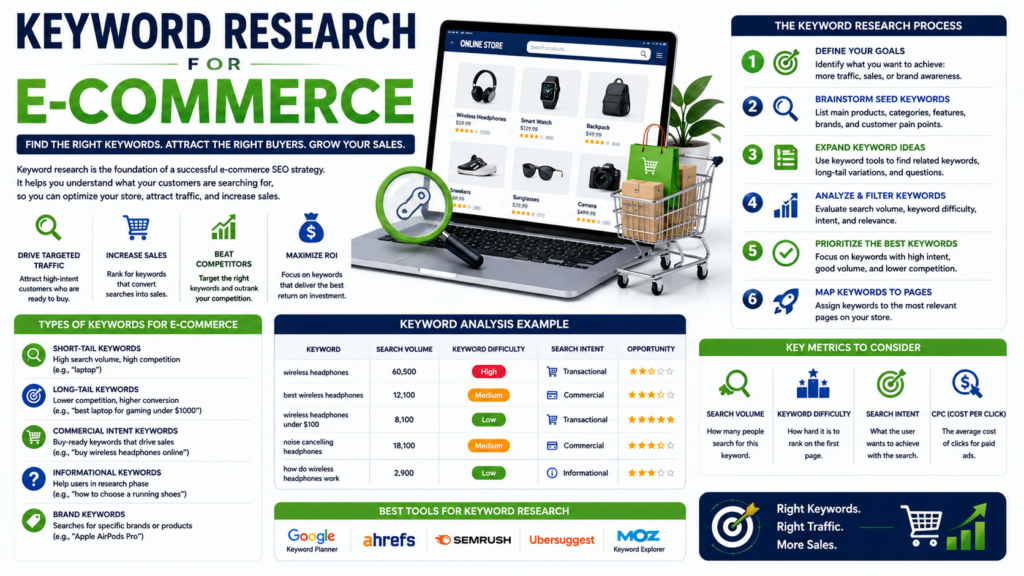
E-commerce keyword research requires finding not just informational keywords (how to use X) but transactional keywords, the searches people make when they are ready to buy. These include product names, model numbers, comparison searches like ‘Product A vs Product B’, and intent phrases like ‘buy’, ‘best’, ‘cheap’, ‘discount’.
Also target ‘category-level’ keywords that cover broad product types your store sells, as these can drive enormous traffic when your category pages rank well.
Optimizing Product Pages
Your product pages are your most important pages. Every product page should have a unique, keyword-rich title tag. Avoid duplicate content, write unique, detailed descriptions for every product even if they are variations of the same item. Add high-quality product images with descriptive alt text. Include customer reviews on product pages (they add unique content and social proof). Use structured data markup so Google can display rich product results with price and availability directly in search results.
High-converting product pages rely heavily on quality Content Writing that balances SEO optimization with persuasive sales copy.
Category Page Optimization
Category pages are often the highest-traffic opportunity in e-commerce SEO. Treat them like landing pages. Add a well-written, keyword-optimized paragraph of text at the top or bottom of each category page. Ensure category page titles and meta descriptions are unique and compelling.
Handling Duplicate Content
E-commerce sites are notorious for duplicate content issues caused by URL parameters for sorting and filtering (like /products?sort=price). Use canonical tags to point Google to the correct version of each page. Manage crawl parameters in Google Search Console to prevent Google from wasting its crawl budget on irrelevant filter combinations.
Managing duplicate content, crawl budget, and indexing issues becomes easier when you understand core Technical SEO fundamentals.
Building Backlinks for E-commerce
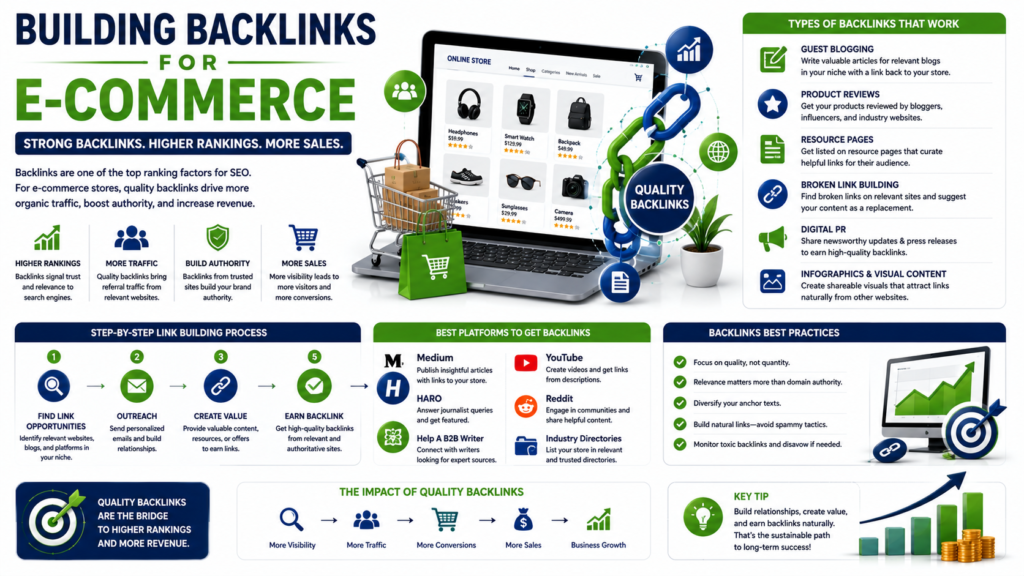
Link building for e-commerce focuses on earning links to both your category pages and informational content. Creating a blog with buying guides, product comparisons, and how-to content gives other websites something valuable to link to. Our Guest Posting service can secure authoritative links to your most important pages.
Our Guest Posting service can secure authoritative links to your most important pages.
Site Architecture for E-commerce
The ideal e-commerce site structure is shallow, meaning any product can be reached in three clicks or fewer from the homepage. Deep, buried pages rarely rank well because they receive fewer internal links. A clean site architecture helps both users and Google navigate your store efficiently.
Our Web Development team builds e-commerce sites with SEO-optimized architecture built in from day one.
Frequently Asked Questions About E-commerce SEO
Q1: How long does e-commerce SEO take to produce results?
Most e-commerce sites see meaningful ranking improvements within three to six months of consistent optimization. Highly competitive product categories take longer.
Q2: Should I create a blog for my e-commerce store?
Absolutely yes. A blog allows you to target informational keywords, attract links, and build the domain authority that lifts your product pages higher in rankings.
Q3: Is SEO or paid advertising better for e-commerce?
Both have their place. Paid advertising produces immediate results and is great for new products or time-sensitive promotions. SEO builds long-term, cost-effective organic visibility. The most successful e-commerce businesses use both.
Q4: How important are product reviews for SEO?
Very important. Reviews add unique user-generated content to your product pages, help pages rank for long-tail keyword variations that appear in reviews, and provide strong social proof that improves conversion rates.
Q5: Can I get professional help with my e-commerce SEO?
Yes. Sky Rocket Rankings works with e-commerce businesses of all sizes. Contact us for a free strategy consultation.
